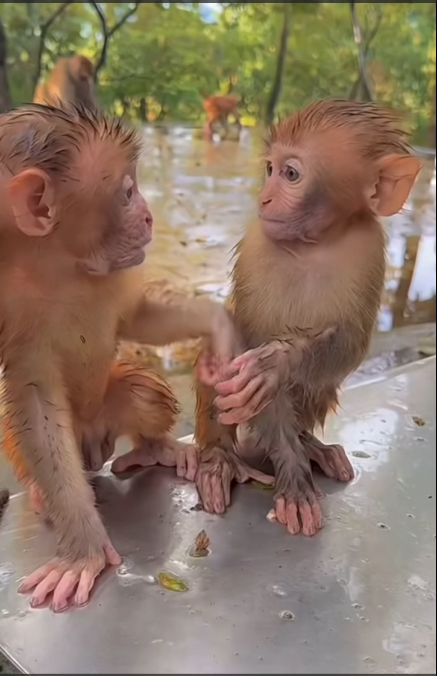
The first time I witnessed baby monkeys engaging in what looked like a fight, I didn’t quite know how to react. At first glance, it seemed intense—tiny bodies darting back and forth, high-pitched squeaks filling the air, and little hands grabbing, pushing, and tumbling over one another. My heart skipped a beat as I wondered if I was seeing something too rough, something that might turn serious. But as I continued to watch, I realized there was something far more fascinating unfolding in front of me.
These weren’t just random acts of aggression. This was play-fighting—an essential part of growing up in the monkey world. Still, there was something different about this particular encounter. It wasn’t the gentle, almost slow-motion wrestling I had seen in videos before. This felt more energetic, more competitive, and, honestly, more exciting to watch.
The two baby monkeys squared off like tiny warriors. One crouched low, eyes locked on its playmate, while the other bounced lightly on its feet, almost teasing. Then, in a flash, they lunged at each other. Their movements were quick but not chaotic. There was rhythm to it, like a dance they both somehow understood without ever being taught.
They rolled across the ground, kicking and grabbing, occasionally pausing just long enough to reassess before diving back in. Every now and then, one would let out a squeal that sounded dramatic, almost as if it were saying, “Hey, that was too much!” But just as quickly, it would reengage, proving that no real harm had been done.
What made this moment especially interesting was the balance between intensity and innocence. Even though it looked like a fight, there were clear signs that it was all in good fun. There were no signs of fear, no desperate attempts to escape. Instead, there was curiosity, excitement, and a clear sense of enjoyment. It reminded me of how human children play—roughhousing, testing boundaries, and learning through interaction.
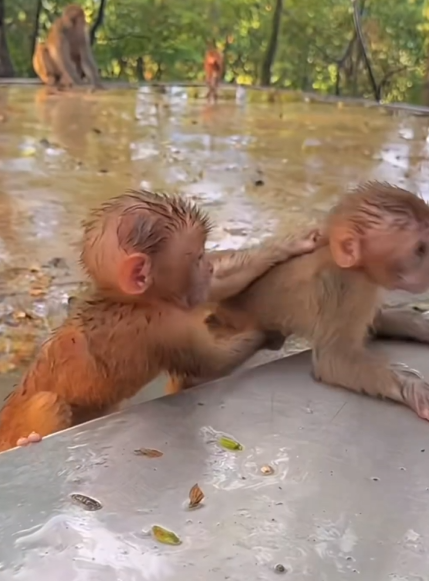
As I watched more closely, I noticed subtle behaviors that made the scene even more fascinating. When one monkey seemed to gain the upper hand, it didn’t press too hard. Instead, it would pause, almost giving the other a chance to recover. This unspoken rule kept the interaction from becoming truly aggressive. It was as if both participants understood the importance of fairness, even at such a young age.
Their faces were incredibly expressive. Wide eyes, quick glances, and playful gestures told a story beyond the physical action. At one point, one of the baby monkeys paused and tilted its head, almost as if it were thinking, “What should I do next?” That brief moment of stillness made the next playful attack even more surprising.
Another thing that caught my attention was how quickly their energy shifted. One moment they were locked in a fierce tumble, and the next, they were sitting side by side, catching their breath. It was a reminder that this wasn’t about winning or losing. It was about learning—learning strength, coordination, social cues, and even trust.
Because trust is really at the heart of it all. Even in the middle of what looked like a heated fight, there was an underlying understanding between them. They trusted each other not to go too far. They trusted that the game would remain just that—a game.
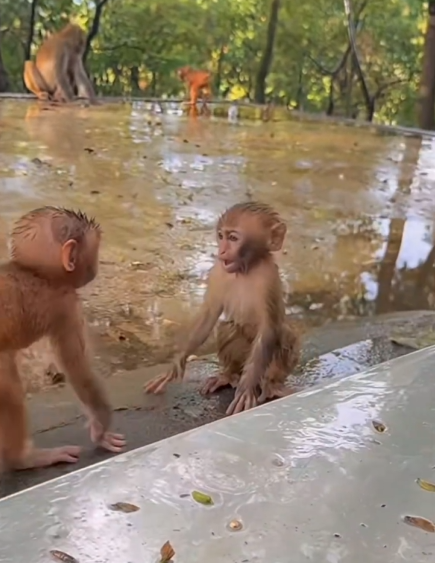
The environment around them also added to the excitement. Whether it was the rustling leaves, the uneven ground, or the occasional interference of another curious monkey, everything seemed to contribute to the unpredictability of the scene. At one point, a third baby monkey approached, watching intently as if deciding whether to join in. For a moment, it felt like the fight might turn into a full-on group play session, but instead, the newcomer simply observed, learning from a distance.
Watching this unfold made me realize how important these moments are in the development of young animals. It’s not just entertainment—it’s practice for life. Through play-fighting, they develop the skills they’ll need as adults. They learn how to defend themselves, how to interact with others, and how to navigate the complex social structures of their group.
And yet, despite all this deeper meaning, there was something undeniably entertaining about it. The unpredictability, the bursts of energy, the sudden pauses—it all combined to create a scene that was hard to look away from. I found myself smiling, completely drawn into their tiny world.
What surprised me the most was how emotionally engaging it was. I started to root for them, even though there was no real competition. I laughed when one monkey dramatically flopped onto its back, as if defeated, only to spring up seconds later with renewed energy. I felt a slight tension during the more intense moments, even though I knew it was all part of the game.
By the time the play-fight finally slowed down, both baby monkeys seemed satisfied. They sat close to each other, their earlier intensity replaced by calm companionship. It was a gentle ending to an exciting display, almost like the closing scene of a story.
Reflecting on the experience, I realized that what made it so special wasn’t just the action itself, but the glimpse it provided into their world. It showed me that even in what looks like chaos, there can be structure, purpose, and connection.
For a first-time experience, it was unforgettable. It changed the way I see animal behavior, especially in young creatures. What might seem like a simple fight at first glance is actually a complex and meaningful interaction.
And honestly, I can’t wait to watch it again.