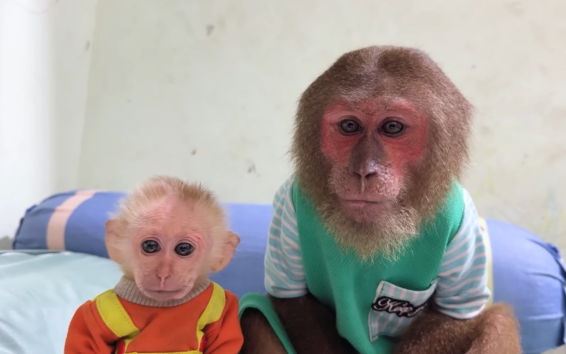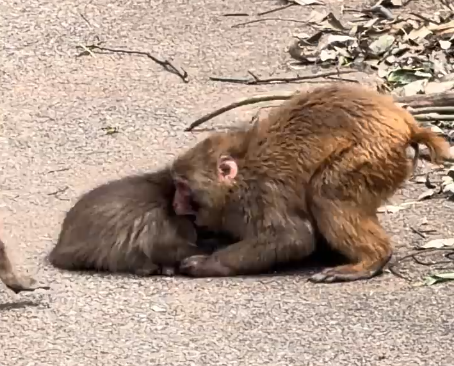
In a quiet corner of a small, crowded neighborhood, there lived a tiny monkey known by everyone as Punch. The name sounded playful, almost funny, but the story behind it was far from lighthearted. Punch had not always been the cheerful, curious little creature people saw today. Once, his world had been filled with fear, confusion, and a kind of heartbreak that even animals seem to understand deeply.
No one knew exactly where Punch came from. Some said he had been separated from his mother too early. Others believed he had wandered into the wrong place at the wrong time. But what everyone could agree on was that when Punch first appeared, he was different. He didn’t climb joyfully like other monkeys. He didn’t chatter or play. Instead, he kept his distance, watching everything with wide, cautious eyes.
At the slightest movement, he would flinch.
If someone reached out, he would retreat.
And if another monkey got too close, he sometimes reacted in the only way he seemed to know—he would lash out, throwing tiny punches with surprising speed. That’s how he got his name. “Punch the Monkey,” people would say, half amused, half concerned. It was easier to laugh than to think about what had made such a small creature so defensive.
But beneath that tough exterior was something else—something fragile.
One afternoon, as the sun hung low in the sky, a kind-hearted woman who lived nearby noticed Punch sitting alone. While the other monkeys played, chased each other, and leaped across branches, Punch stayed on the edge, hugging himself as if trying to stay invisible.
She didn’t approach him right away. Instead, she sat a few feet away and simply watched. Minutes passed. Then more. Punch noticed her, of course. His eyes flickered toward her again and again, ready to run at any sign of danger.
But she didn’t move suddenly. She didn’t reach out. She didn’t try to force anything.
She just stayed.
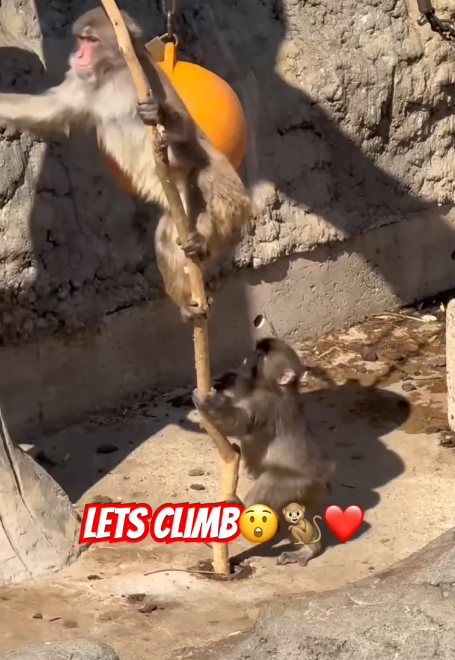
Over the next few days, she returned at the same time, sitting in the same spot. Sometimes she brought a small piece of fruit and placed it on the ground before stepping back. At first, Punch ignored it. Then, curiosity began to win over fear. Slowly, cautiously, he would inch closer, grab the fruit, and retreat again.
It was a small step, but it meant everything.
Trust doesn’t come easily, especially for those who have been hurt. And Punch had clearly learned that the world could be unpredictable, even cruel. But this quiet routine began to change something inside him. The presence of someone who expected nothing in return, who didn’t demand affection or obedience, created a space where he could begin to feel safe.
Weeks went by.
Punch stopped flinching as much.
He stayed a little closer.
His eyes, once filled with constant alertness, began to soften.
One day, something remarkable happened. As the woman placed a piece of fruit down, Punch didn’t run away after grabbing it. Instead, he lingered. He looked at her, tilting his head slightly, as if trying to understand her.
Then, in a moment that felt almost unreal, he took a few small steps toward her.
The woman stayed perfectly still, her heart racing but her body calm. She knew that one wrong move could undo all the progress they had made. Punch reached out, his tiny hand hovering uncertainly before gently touching her fingers.
It wasn’t a punch.
It was the opposite.
It was the beginning of something new.
From that day on, everything started to change. Punch became more curious, more open. He still had moments of hesitation, moments where old instincts kicked in, but they grew fewer and farther between. Instead of pushing others away, he began to explore connection.
And then came the moment no one expected.
One evening, as the sky turned shades of orange and pink, Punch climbed down and approached the woman as usual. But this time, instead of stopping at a safe distance, he came closer—closer than ever before.
He climbed onto her lap.
For a second, he froze, as if unsure of what he was doing. The woman held her breath, afraid to even blink. And then, slowly, gently, Punch leaned into her.
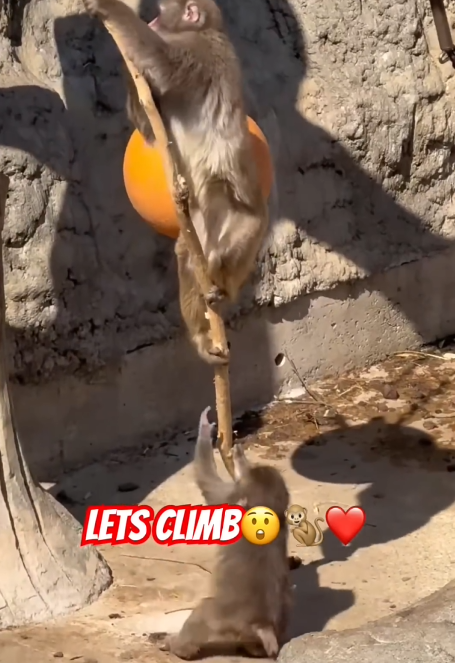
It was a hug.
A small, quiet, but incredibly powerful hug.
All the fear, the loneliness, the heartbreak—it didn’t disappear instantly, but in that moment, it felt like something had shifted. The monkey who once pushed the world away with tiny fists was now reaching out, choosing connection over defense.
From heartbreak to hugs.
The transformation didn’t go unnoticed. The other monkeys, once wary of Punch’s unpredictable behavior, began to accept him. He started to join their games, hesitantly at first, then with growing confidence. There were still playful scuffles, of course, but they were different now. They were no longer fueled by fear, but by joy.
Punch learned that not every interaction was a threat. That not every approach meant harm. That sometimes, reaching out didn’t lead to pain—it led to warmth.
And for the people who had watched his journey, Punch became more than just a monkey with a funny name. He became a reminder. A reminder that behavior often has a story behind it. That what looks like aggression can sometimes be a shield for something much deeper.
Most importantly, he showed that change is possible.
It takes patience. It takes understanding. It takes someone willing to sit quietly, to show up again and again without forcing anything. But even the most guarded hearts can open, given the right conditions.
Punch still had his moments. Every now and then, if something startled him, he might raise his tiny fists again. But those moments passed quickly, replaced by something stronger than fear.
Trust.
Connection.
And yes, even love.
In the end, Punch the Monkey was no longer defined by his punches. He was defined by his journey—from a place of heartbreak to a place of hugs. And in that journey, he taught everyone around him something truly unforgettable: sometimes, the smallest acts of kindness can lead to the biggest transformations.