When we first saw Sona, no one spoke.
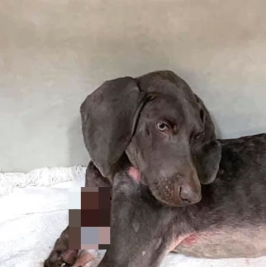
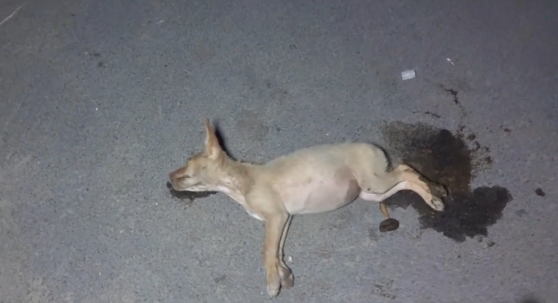
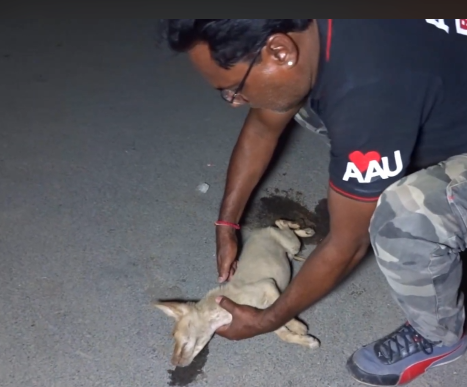
She lay on her side near the edge of a dusty road, her body unnaturally still except for the faint rise and fall of her chest. A small crowd had gathered at a distance, unsure what to do, whispering quietly as if sound alone might shatter what little life remained in her.
“Is she… still alive?” someone asked.
Barely.
Her eyes were half-open but unfocused, staring at nothing. There was a deep wound on her head, and dried blood had matted the fur around her face. One side of her body twitched slightly, while the other seemed completely unresponsive.
She was close to death.
We didn’t know what had happened—maybe a car accident, maybe something worse—but it was clear she had suffered severe trauma. A brain injury, we suspected immediately.
There was no time to waste.
We moved quickly but carefully, lifting her fragile body onto a blanket. She didn’t react. No resistance, no fear—just silence.
That silence was terrifying.
The drive to the clinic felt longer than it was. Every bump in the road made us wince, worried we might be causing her more pain. We kept talking to her, softly, hoping that somewhere deep inside, she could hear us.
“Stay with us, Sona… just a little longer.”
We didn’t even know her name yet. But somehow, she needed one.
At the veterinary clinic, the team rushed into action. Oxygen. IV fluids. Emergency assessment.
The diagnosis confirmed our fears: significant head trauma, likely causing brain injury. There were neurological symptoms—lack of coordination, delayed responses, and partial paralysis on one side.
“She’s critical,” the vet said quietly. “The next 24 hours will decide everything.”
Those hours felt endless.
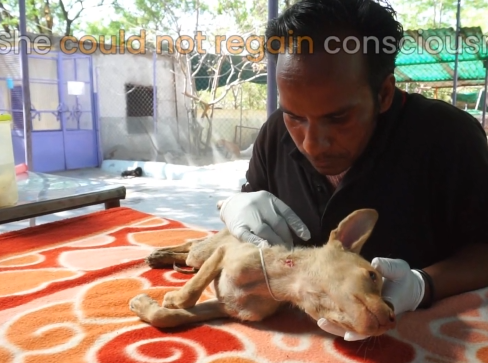
Sona was placed in a quiet, monitored space. Tubes helped her breathe more easily. Medication worked to reduce swelling in her brain. Every small movement, every change in her breathing, was watched closely.
We waited.
And hoped.
That night, no one slept much.
The next morning, we braced ourselves before walking in.
She was still there.
Still breathing.
It was a small miracle—but a miracle nonetheless.
Over the next few days, progress was slow. Painfully slow.
Sona began to show faint signs of awareness. A slight movement of her head. A blink that seemed more intentional than before. But her body remained weak, and her coordination was almost nonexistent.
She couldn’t stand.
She couldn’t walk.
Sometimes, she couldn’t even hold her head up.
But she was fighting.
And that’s what kept us going.
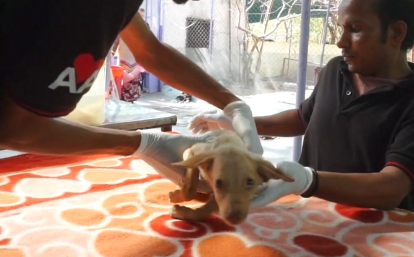
We started gentle therapy as soon as it was safe. Simple things at first—helping her sit upright, supporting her as she tried to move her legs, encouraging her to respond to touch and sound.
At times, it seemed impossible.
There were setbacks—days when she seemed to regress, when her body refused to cooperate, when exhaustion overtook her completely.
But then there were moments.
Tiny, powerful moments.
One afternoon, as a volunteer gently called her name, Sona turned her head.
It wasn’t much.
But it was everything.
“She heard that,” someone whispered.
From that day on, we saw something new in her eyes.
Awareness.
Connection.
The fog was beginning to lift.
Weeks passed, and Sona continued to fight in ways that left us in awe. With support, she began to stand—her legs shaky, her balance uncertain, but standing nonetheless.
The first time she took a step, it was uneven, almost like she might fall at any moment.
But she didn’t.
She tried again.
And again.
Each step was a victory.
Her brain was slowly relearning what her body once knew. It wasn’t easy. There were moments of frustration—visible even in her gentle eyes. But she never gave up.
Not once.
We adjusted her therapy, adding more exercises to help her regain strength and coordination. Soft mats, guided walking, even simple games to stimulate her mind.
And then came the day none of us will ever forget.
Sona walked across the room.
On her own.
No support.
No assistance.
Just determination.
We stood there, watching in stunned silence as she made her way forward, step by step, until she reached us.
And then—she wagged her tail.
It was the first time we had seen it.
That simple, beautiful motion brought tears to more than one pair of eyes.
“She’s really coming back,” someone said.
And she was.
Sona’s transformation didn’t happen overnight. It was built day by day, moment by moment, through pain, effort, and an incredible will to live.
Her personality began to shine through as she recovered. She was gentle, affectionate, and quietly brave. She leaned into every touch, every kind word, as if she understood how close she had come to losing it all.
But she hadn’t.
She was still here.
And she was stronger than anyone had expected.
Months later, Sona was almost unrecognizable from the dog we first found. Her fur had grown back, her eyes were bright and full of life, and her body—though still carrying small reminders of her injury—moved with confidence and grace.
She could run.
She could play.
She could live.
The scars of her past remained, but they no longer defined her.
Instead, they told a story.
A story of survival.
Of resilience.
Of a spirit that refused to give up, even when everything seemed lost.
Sona’s recovery reminds us that healing isn’t always perfect. It’s not always fast. And sometimes, it requires more patience than we think we have.
But it’s possible.
Even in the darkest moments.
Even when hope feels far away.
Because sometimes, all it takes is one life that refuses to let go.
And Sona… never did.