When I first heard about doing yoga in heels, I honestly thought it was a joke. Yoga is supposed to be about grounding yourself, feeling connected to the earth, and moving with balance and control. Heels, on the other hand, are all about elevation, style, and—let’s be honest—instability. Combining the two sounded like a recipe for disaster.
But then I saw Mirracle do it.
There was something bold, confident, and unexpectedly graceful about the way she moved. She wasn’t just balancing in heels—she was flowing, stretching, and owning every second of it. That’s when I decided to try the challenge myself.
I called it: CHALLENGE YOGA IN HEELS.
And I had no idea what I was getting into.
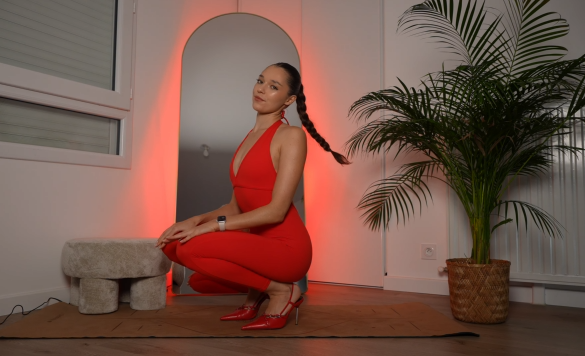
The first step was choosing the right heels. That alone felt like a challenge. Too high, and I risked losing balance instantly. Too low, and it wouldn’t feel like a real test. I finally settled on a pair of mid-height heels—still intimidating, but manageable.
Standing on the mat felt completely different.
Usually, when I start yoga, I feel grounded—feet flat, stable, connected. But in heels, everything changed. My weight shifted forward, my calves immediately engaged, and my balance felt uncertain. Even standing still required focus.
I took a deep breath.
This was going to be interesting.
I began with a simple warm-up. Gentle neck rolls, shoulder stretches, and slow arm circles. Even these basic movements felt different because my center of gravity had shifted. I had to engage my core more, stabilize through my legs, and stay completely aware of every movement.
Then came the first real test: a forward fold.
Normally, I would hinge at the hips and fold down easily, letting my hands reach toward the floor. But in heels, it felt like I was tipping forward. I had to move slowly, carefully controlling each inch. My hamstrings stretched deeply, but my focus was split between flexibility and balance.
I didn’t fall—but I definitely wobbled.
And that was just the beginning.
Next, I moved into a lunge position. One foot forward, one foot back. This is usually a grounding pose, but in heels, it felt like balancing on a narrow edge. My back heel—already elevated by the shoe—made it even more challenging. My legs trembled slightly as I held the position.
But something surprising happened.
I felt stronger.
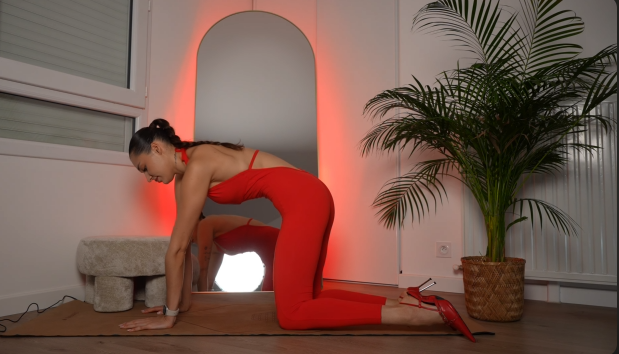
Because the instability forced my muscles to work harder. My core tightened, my legs engaged, and my focus sharpened. I wasn’t just stretching—I was fully present in my body.
As I continued, I began to understand what made this challenge so unique.
It wasn’t just about flexibility. It was about control.
Every movement required intention. There was no rushing, no careless transitions. If I moved too quickly, I risked losing balance. So I slowed down. I listened to my body. I became more aware of how I shifted my weight, how I placed my feet, how I held each pose.
Then came the real challenge: the split stretch.
I hesitated for a moment.
Doing a split on the floor is one thing. Doing it in heels? That felt almost impossible. But I reminded myself—this was a challenge. Not about perfection, but about trying.
I carefully extended one leg forward and the other back, lowering myself slowly. My hands stayed on the mat for support, and I moved inch by inch, feeling the stretch deepen.
The heels made everything harder.
My front foot felt less stable, and my back leg struggled to stay aligned. But I kept breathing. Inhale. Exhale. Relax.
And somehow… I went lower.
Not all the way—but lower than I expected.
That moment felt powerful.
Because it proved something important: even in an unstable, uncomfortable situation, progress is still possible.
I held the stretch for a few seconds, then slowly came out of it, careful not to lose balance. My legs were shaking, but I felt energized.
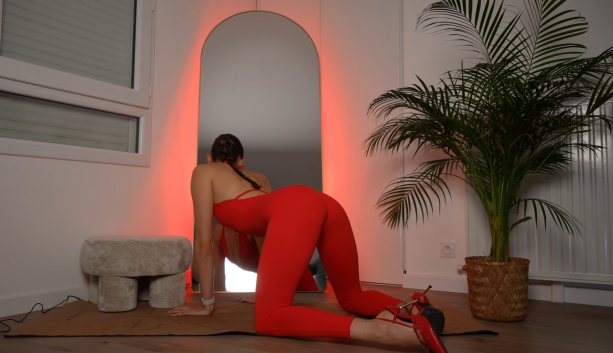
The challenge continued with more full-body stretches—side bends, gentle twists, and even a modified downward dog. That pose, in particular, was surprisingly intense. My arms worked harder to support me, while my legs stretched deeply. The angle created by the heels added a new level of difficulty.
But also—a new level of awareness.
By the end of the session, I was sweating more than I expected. Not from fast movement, but from constant engagement. Every muscle had played a role in keeping me stable.
And mentally, I felt focused.
There was no room for distraction during yoga in heels. I had to stay present, or I would lose balance. That kind of focus turned the entire experience into something almost meditative.
When I finally stepped out of the heels, I felt an immediate difference.
My feet relaxed, my posture shifted, and I felt grounded again. But I also felt stronger—like I had challenged my body in a completely new way.
Looking back, the experience was more than just a fun trend or a bold experiment.
It was a reminder that growth often comes from stepping outside your comfort zone. Doing something unusual, even a little ridiculous, can teach you a lot about your body and your mindset.
Would I recommend yoga in heels every day? Probably not.
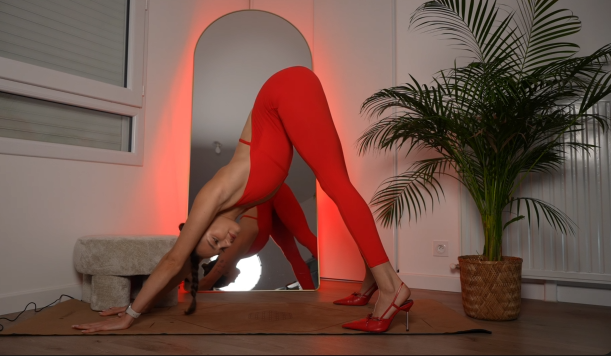
But as a challenge? Absolutely.
It pushes you to improve your balance, strengthen your muscles, and develop greater body awareness. And let’s not forget—it’s also a lot of fun.
There’s something empowering about moving confidently in heels while doing something as controlled and mindful as yoga. It breaks the rules in the best way possible.
Mirracle’s inspiration showed me that fitness doesn’t always have to follow tradition. It can be creative, bold, and even a little daring.
So if you’re looking for something different—something that challenges both your body and your confidence—why not give it a try?
Put on your heels.
Step onto the mat.
And see what your body is capable of.
You might wobble.
You might laugh.
You might even surprise yourself.
Because sometimes, the most unexpected challenges bring the most rewarding results.