The alley behind the restaurant was always alive at night—clattering dishes, the hiss of steam, and the faint smell of grilled meat drifting into the darkness. For most, it was just another forgotten corner of the city. But for one small puppy, it was everything.
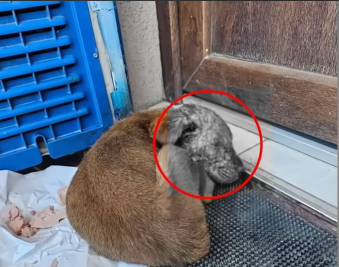
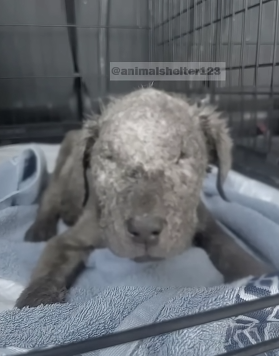
He had no name. No one had ever called him anything except “shoo” or “get away.” His fur, once soft and golden, was now matted and dirty, clinging to his fragile body. Hunger had carved sharp lines into his ribs, and his legs trembled from exhaustion. But it wasn’t just hunger that made him weak.
It was the burns.
No one knew exactly how it had happened. Maybe he had wandered too close to a street vendor’s stove, or maybe someone had thrown something hot at him to drive him away. All the puppy knew was the sudden, unbearable pain that had wrapped around his small body like fire itself. His skin blistered, his fur singed away in patches, and the world became a blur of agony.
For days, he had wandered the streets, crying softly, his tiny voice barely audible over the noise of the city. People passed him by. Some looked at him with pity, others with disgust, but no one stopped. No one helped.
Until the night he found the restaurant.
The smell drew him in first—a rich, warm scent that made his empty stomach twist painfully. Meat. Rice. Oil. Food. Real food. The kind he hadn’t tasted in what felt like forever.
He stumbled into the alley, each step sending waves of pain through his burned skin. His paws were sore, his body trembling, but he kept going. The smell was too strong, too tempting to ignore.
Near the back door of the restaurant, a man stood smoking, his white chef’s jacket slightly stained from the long day’s work. He looked tired, his shoulders heavy, his eyes distant. He didn’t notice the puppy at first.
The puppy saw him, though.
With what little strength he had left, the puppy let out a soft whimper. It wasn’t loud. It wasn’t demanding. It was just… pleading.
The chef turned.
At first, his expression didn’t change. He had seen strays before. Too many of them. They came and went, always hungry, always desperate. He had learned not to get involved. It was easier that way.
But then he looked closer.
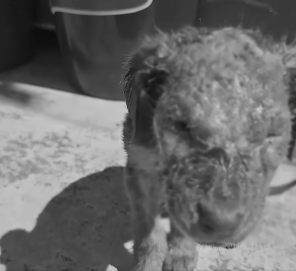
The puppy stood there, barely able to keep himself upright. His small body was covered in burns—angry red patches, some still raw, others already forming scabs. His eyes, wide and glassy, were filled with something deeper than hunger.
They were filled with pain.
And still, he wagged his tail.
Just a little.
As if, despite everything, he still believed.
The chef frowned, flicking his cigarette to the ground. “Hey,” he muttered, more to himself than to the puppy. “What happened to you?”
The puppy took a step forward.
Then another.
Each movement seemed to cost him everything. His legs shook violently, and for a moment, it looked like he might collapse. But he didn’t. He kept going, his eyes never leaving the chef.
And then, finally, he reached him.
The puppy didn’t bark. He didn’t jump. He didn’t do anything but sit—slowly, carefully—and look up.
Begging.
Not for sympathy. Not for kindness.
Just for food.
The chef hesitated.
He had rules. The restaurant had rules. No feeding strays. No bringing animals near the kitchen. It wasn’t allowed. It wasn’t practical. It wasn’t his problem.
But as he looked down at the small, broken creature in front of him, those rules felt… distant.
The puppy let out another soft cry.
It wasn’t loud. It wasn’t dramatic.
It was just… tired.
The chef sighed.
“Damn it,” he muttered.
He turned and pushed open the back door, disappearing into the kitchen. The puppy watched him go, his heart sinking. Maybe he had done something wrong. Maybe he wasn’t supposed to come here. Maybe—
The door opened again.
The chef stepped out, holding a small plate.
The smell hit the puppy instantly, stronger than before. Rice. Meat. Warm, fresh, real. His nose twitched, his body trembling with anticipation.
The chef crouched down, placing the plate on the ground.
“Here,” he said gruffly. “Eat.”
For a moment, the puppy didn’t move.
It was as if he couldn’t believe it.
Then, slowly, he leaned forward.
The first bite was hesitant, almost careful. But the moment the food touched his tongue, something changed. Hunger took over. Desperation surged through him.
He ate.
Not neatly. Not politely. But with a kind of urgency that spoke of days—maybe weeks—without a proper meal. Each bite was fast, almost frantic, as if he feared the food might disappear at any moment.
The chef watched in silence.
Something in his chest tightened.
“Slow down,” he muttered, though he knew the puppy wouldn’t understand.
When the plate was empty, the puppy licked it clean, then looked up again. Not demanding more. Just… looking.
His tail wagged weakly.
The chef exhaled.
“You’re a mess,” he said quietly.
Carefully, he reached out.
The puppy flinched at first, his body tensing, expecting pain. But the touch that came was gentle. Careful. Different.
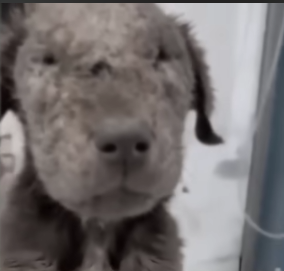
The chef’s hand hovered over the burned patches, not pressing, just… acknowledging.
“Must’ve hurt,” he murmured.
The puppy leaned into the touch.
Just a little.
That was all it took.
The chef shook his head. “I shouldn’t do this,” he said under his breath. “I really shouldn’t.”
But he already knew he would.
He stood, then bent down and carefully scooped the puppy into his arms. The small body was lighter than he expected, fragile, trembling. The puppy let out a soft whine but didn’t resist.
“It’s okay,” the chef said. “I’ve got you.”
The alley, once cold and unforgiving, seemed to fade as he carried the puppy inside.
For the first time in a long time, the puppy wasn’t alone.
For the first time since the fire, since the pain, since the endless hunger, there was something else.
Warmth.
Not just from food.
But from kindness.
And as the puppy rested his head against the chef’s chest, his eyes slowly closing, he seemed to understand something simple, something small, yet powerful.
He hadn’t begged in vain.
He hadn’t suffered for nothing.
Because sometimes, even in a world that turns away, all it takes is one person to stop.
One moment.
One act of kindness.
And everything can change.