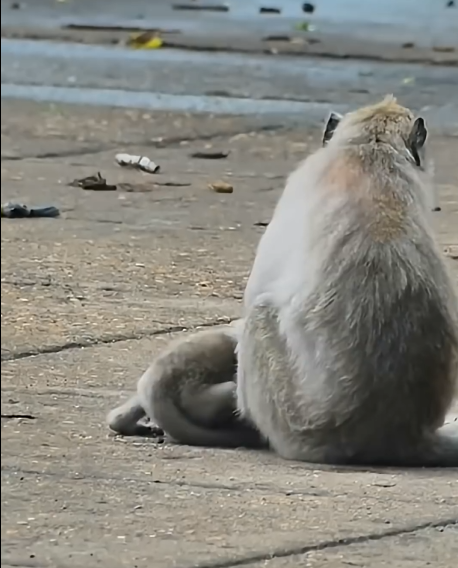
In the dense forest canopy, life moves according to instinct, rhythm, and survival. Every sound, every movement, every interaction between animals carries meaning shaped by generations of adaptation.
High above the ground, a mother monkey sat with her young baby clinging tightly to her chest.
The infant was still in an early stage of development—small, energetic, and completely dependent on her. It reached for her constantly, seeking comfort and milk, as most young primates do. Nursing is not only nourishment; it is also reassurance, warmth, and connection.
But as the baby grows, its needs begin to change.
The forest does not allow endless dependence. A young monkey must gradually learn to explore, to observe, and eventually to feed independently. This transition is called weaning, and it is a natural but sometimes difficult process.
That morning, the mother monkey was resting on a thick branch. Sunlight filtered through the leaves, casting shifting patterns across her fur. The baby, however, was restless. Even though it had fed not long before, it continued to reach for her, whining softly and trying to nurse again.
At first, the mother responded with patience.
She adjusted her position, gently moving the baby slightly aside while maintaining closeness. In primate behavior, mothers often use subtle physical guidance rather than aggression—shifting bodies, blocking access, or turning away to signal that feeding time is over.
The baby did not immediately understand.
It tried again, clinging tighter, insisting on nursing despite the mother’s clear signals. This persistence is natural; infants rely heavily on instinct before they fully learn social boundaries.
But in the wild, persistence alone cannot always be rewarded.
The mother monkey shifted more firmly this time, placing her arm between herself and the baby, preventing access. The movement was quick and decisive—not harmful, but clear in intent. The baby was gently pushed back a short distance on the branch.
It startled, losing balance for a moment before regaining its grip. It cried out briefly, confused by the sudden interruption.

The mother watched closely.
This was not rejection. It was instruction.
In monkey societies, learning often comes through repeated correction. Young monkeys are not simply given everything they want; they are guided toward independence through consistent responses from their caregivers.
The baby tried once more to reach her, but again the mother blocked it, this time turning slightly away. The message was becoming clearer: nursing would not continue right now.
Frustration rose in the infant. It vocalized again, clinging and reaching, but the mother remained steady. She did not escalate aggression, but she did not give in either.
This balance is critical in primate development. Too much indulgence can delay independence, while too little support can endanger survival. Mothers must constantly navigate this line.
After several attempts, the baby paused.
It still looked confused, still restless, but something had shifted. The immediate demand was no longer being reinforced. Instead, the baby was being guided toward patience.
The mother used this moment to groom it briefly, a soft and calming gesture. She picked through its fur, reinforcing connection in a non-feeding way. Grooming is an important social behavior in monkeys, used to strengthen bonds while also reducing tension.
The baby slowly relaxed.
It stayed close, but stopped trying to nurse for the moment. Its attention drifted toward nearby movement in the trees—other monkeys jumping between branches, birds calling in the distance, the shifting world around it.
This shift outward is an important developmental step.
As the day continued, the baby attempted fewer nursing demands. Instead, it began to explore small movements along the branch, always returning to the mother for reassurance but not constantly insisting on feeding.
The mother remained attentive. She did not abandon the baby’s needs, but she also did not allow constant dependence. This is how primate mothers gradually guide their offspring toward independence.
Weaning is not a single event.

It is a process of adjustment, communication, and repeated boundaries.
The mother monkey occasionally repositioned herself when the baby came too close, reinforcing limits without aggression. Each time, the baby learned a little more about timing, patience, and distance.
By midday, a quiet rhythm had formed between them.
The baby stayed near, but no longer demanded constantly. It observed, rested, and explored within a small safe range. The mother rested more easily, no longer needing to respond to continuous nursing attempts.
In the forest, survival depends on this balance.
Too much dependence can weaken a young animal’s ability to adapt later in life. But too much separation too early can create vulnerability. The mother’s role is to guide the transition carefully, using instinct and experience.
As the light shifted through the trees, the baby settled beside her, calm and close. The tension of the morning had eased, replaced by quiet companionship.
Nothing dramatic remained.
Only learning.
Only growth.
And in the natural rhythm of the forest, that is how independence begins—not through sudden change, but through steady guidance, firm boundaries, and the slow understanding that care does not always mean immediate satisfaction.