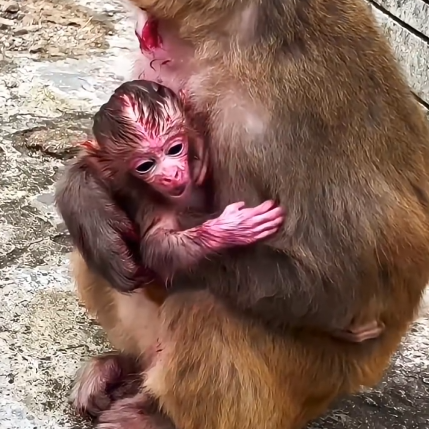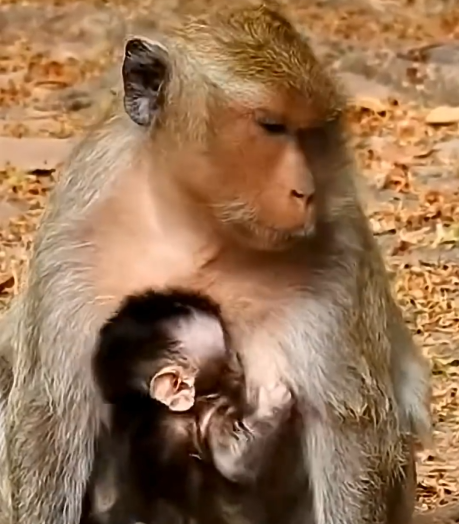
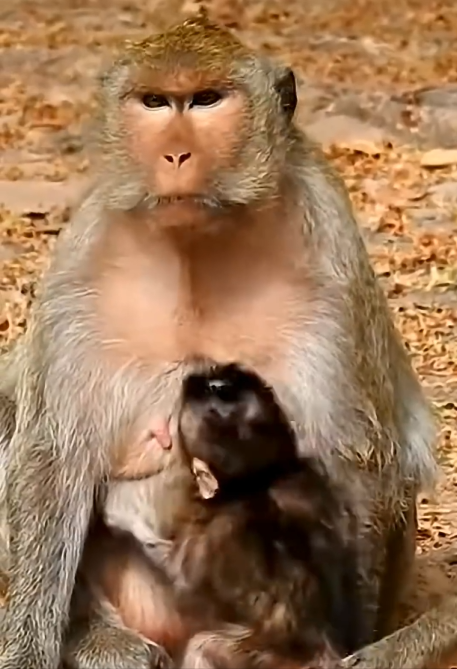
In the dense green canopy of the forest, life moves in constant motion—branches swaying, leaves rustling, and distant calls echoing through the trees. Within this living world, every creature has its place, its role, and its instincts that guide survival. Among them, a mother monkey held tightly to her baby, alert and protective, watching every movement around her with careful eyes.
Her baby was small, still clinging to the earliest stages of life. It stayed close to her chest most of the time, gripping her fur with tiny hands that trusted her completely. For the baby, the world was simple: warmth, safety, and the presence of its mother. For the mother, however, everything was responsibility.
Every sound mattered. Every shadow mattered. Every approaching figure mattered.
In monkey groups, social interaction is complex. They live in communities where many individuals coexist, play, compete, and communicate. Sometimes, younger monkeys interact closely with others in the group, and curiosity often leads them to approach different members. But for a mother with a very young infant, boundaries become sharper, instincts stronger, and protection absolute.
That morning, the troop was active.
Several monkeys moved through the branches nearby, jumping between trees, grooming each other, and searching for food. It was a normal day in the forest, full of energy and noise. But the mother monkey stayed slightly apart, positioned carefully on a thick branch where she had a clear view of her surroundings.
Her baby shifted slightly in her arms, making small sounds, occasionally reaching out toward movement nearby. It was curious, as young animals often are. Everything around it was new, interesting, and worth exploring.
But the mother did not allow distance.
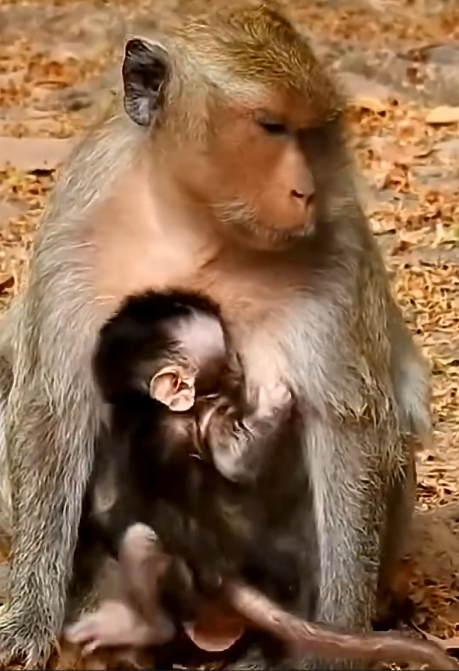
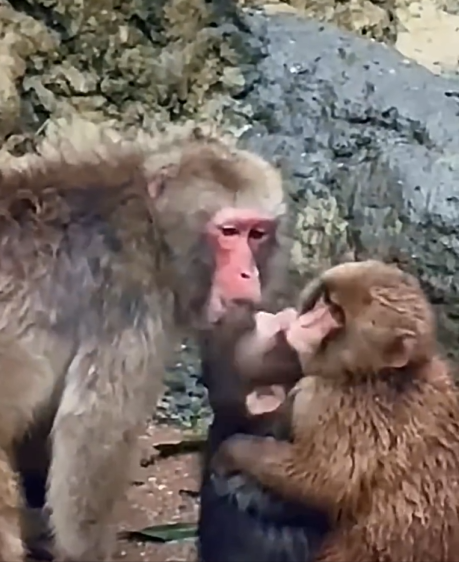
When one of the younger monkeys from the group approached too closely, the mother immediately reacted. Her body tensed, and she shifted her position, pulling her baby tighter against her chest. Her eyes followed the approaching monkey closely, watching every step.
The other monkey paused, sensing the protective energy.
In primate behavior, such moments are not unusual. Mothers are highly protective of their infants, especially during the early months. Even within the same group, boundaries around babies are respected, and any approach is carefully judged.
The approaching monkey tried again, moving slightly closer, curious about the infant. But the mother responded again—this time more firmly. She moved sideways along the branch, creating distance, keeping her body between her baby and the other monkey.
Her message was clear without words: do not come closer.
The baby shifted in her arms, unaware of the tension but sensitive to her movement. It clung tighter, sensing her alertness. The mother gently adjusted her grip, ensuring the baby was secure while never taking her eyes off the others.
Another monkey appeared nearby, and for a brief moment, there were multiple eyes watching the mother and her infant. But she remained steady. Her posture was strong, protective, and unwavering.
She would not allow unnecessary contact.
Not because the other monkeys were dangerous in intention, but because infants in the wild are vulnerable. Even playful interactions can become overwhelming or unpredictable for a baby that is still developing awareness and strength.
The mother understood this instinctively.
She shifted again, moving higher along the branch, placing herself in a more isolated position. The elevation gave her safety and control over space. From there, she could observe everything while keeping her baby out of reach.
The other monkeys eventually lost interest and moved away, returning to their own activities. The tension in the air softened, but the mother remained alert for a while longer, scanning the surroundings carefully.
Only when she was certain the immediate situation had passed did she relax slightly. Even then, she did not fully let her guard down. Her baby was too important, too fragile, too dependent.
She lowered her head briefly, touching her baby gently, reassuring it through contact. The infant responded by settling more comfortably against her, its small body finally calm again.

Moments like this define early life in the wild. Safety is not guaranteed; it is maintained through constant awareness and protective behavior. For a mother monkey, guarding her baby is not a choice—it is instinct, refined by evolution and survival.
As the day continued, the troop moved on. Life in the forest resumed its rhythm—feeding, moving, calling, interacting. But the mother stayed attentive, always keeping her baby close, always aware of distance, always ready to respond.
Occasionally, other monkeys passed nearby, but none came too close again. Whether through understanding or instinctive respect for her boundaries, the space around her remained undisturbed.
The baby, safe in her arms, drifted between wakefulness and rest, unaware of the earlier tension. Its world remained simple and secure, centered entirely on the warmth of its mother.
And the mother remained still, steady, and protective.
In her world, everything could wait—food, movement, rest—but not safety. Not her baby.
Because in the forest, survival is shared, but protection is personal.
And she would not let anyone come too close to what she loved most.