The call came late in the afternoon, just as the sun was beginning to sink behind the buildings, painting the sky in soft shades of gold and orange. I almost didn’t answer. It had been a long day, and I was ready to rest. But something—maybe instinct, maybe fate—made me pick up the phone.
“Hello?”
The voice on the other end sounded tired, almost defeated. “We have a situation,” the woman said. “There’s a puppy here… and honestly, it doesn’t look good.”
I felt a knot form in my stomach. I had heard those words too many times before.
“What’s wrong with him?” I asked.
There was a pause. “Severely malnourished. Weak. Can barely stand. He hasn’t eaten properly in days, maybe longer. The vet here thinks… it might be kinder to put him to sleep.”
I closed my eyes for a second.
“Where are you?” I asked.
An hour later, I was standing in a small, overcrowded shelter at the edge of town. The air smelled faintly of disinfectant, but beneath it was something harder to ignore—the quiet presence of too many animals and not enough time.
She led me to the back.
“He’s here,” she said softly.
I stepped closer.
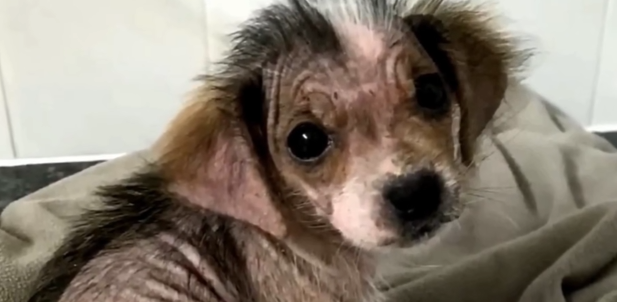
At first, I didn’t even realize I was looking at a puppy. He was so small, so thin, curled into himself like he was trying to disappear. His fur was dull and patchy, his tiny body trembling with each shallow breath. One of his eyes was half-closed, and his ears barely twitched at the sound of footsteps.
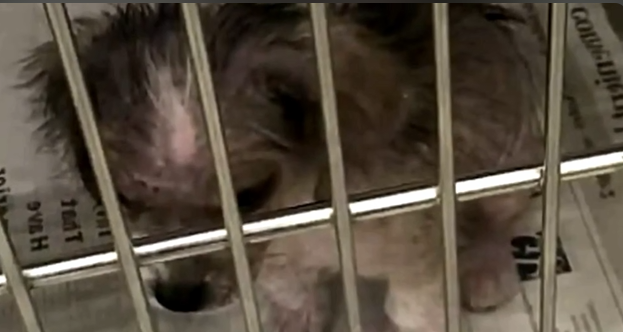
But when I knelt down, he moved.
Just slightly.
His head lifted a fraction, and he looked at me.
That look… I’ll never forget it.
It wasn’t fear.
It wasn’t even pain.
It was something quieter, deeper—like he had already given up, but a small part of him was still waiting to see if he was wrong.
“He’s been like that all day,” the woman said gently. “He doesn’t respond much. We tried feeding him, but he barely eats. He’s just… fading.”
“And the vet?” I asked.
She sighed. “Says he’s suffering. That it might be more humane to let him go.”
I swallowed hard, staring at the tiny, fragile life in front of me.
“What’s his name?” I asked.
“We didn’t give him one,” she replied. “We didn’t think…”
She didn’t finish the sentence.
I understood.
I reached out slowly, placing my hand near him—not touching yet, just letting him feel that I was there.
“Hey, little guy,” I whispered.
For a moment, nothing happened.
Then, almost imperceptibly, he shifted.
His nose moved toward my hand.
It was the smallest gesture.
But it was enough.
“He’s still fighting,” I said quietly.

The woman looked at me, unsure. “You really think so?”
I nodded.
“I’ll take him.”
Her eyes widened slightly. “Are you sure? He might not make it through the night.”
“Then he won’t be alone if he doesn’t,” I said. “But I think… he deserves a chance.”
She hesitated, then gave a small nod. “Okay.”
I wrapped him gently in a soft towel. He was so light it scared me. As I lifted him, he didn’t resist. Instead, he let out a faint sigh and rested against me, as if he had nothing left to give.
“Hang on,” I murmured. “Just hang on a little longer.”
The first night was the hardest.
He refused to eat at first. I had to feed him tiny amounts, slowly, carefully. A little water. A little warmth. I set up a small space for him with blankets, making sure he stayed comfortable.
I didn’t sleep much.
Every time I closed my eyes, I worried he might stop breathing.
But he didn’t.
In the morning, he was still there.
Still weak.
Still fragile.
But alive.
“Good morning,” I whispered, kneeling beside him.
His eyes opened slightly.
That was new.
“Hey,” I said, smiling faintly. “That’s progress.”
Day two brought small changes.
He drank a little more water. Ate a tiny bit of soft food. His head lifted a little higher when I called him.
“Look at you,” I said gently. “You’re stronger than they thought.”
Day three, he tried to stand.
It didn’t last long—his legs trembled, and he collapsed almost immediately—but it was an attempt.
And that mattered.
“You’re not giving up, are you?” I said softly.
By day four, something incredible started to happen.
His eyes began to change.
The dull, distant look was fading, replaced by something brighter. More aware. More present.
He started watching me when I moved around the room. His ears twitched at sounds. He even made a small, soft sound when I walked away, like he didn’t want to be alone.
“Okay, okay,” I laughed quietly. “I’m coming back.”
Day five, he stood again.
This time, he stayed up a little longer.
One step.
Then another.
It was clumsy and slow, but it was movement.
Real movement.
“You did it,” I whispered, my voice thick with emotion.
By day six, he was eating on his own.
Not much—but enough.
And then came day seven.
I woke up to the sound of something soft against the floor.
I sat up quickly, my heart racing.
And there he was.
Standing.
Not trembling.
Not collapsing.
Standing.
His tail moved slightly—just a small wag, but it was there.
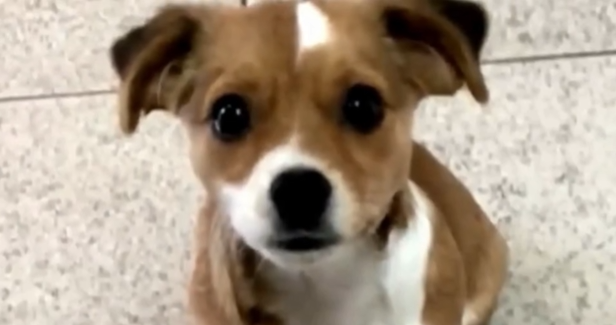
Alive. Stronger. Present.
“Incredible…” I breathed.
I knelt down, holding out my hand.
“Come here.”
He hesitated for a second—just one—and then he walked toward me.
Each step was unsteady, but determined.
And when he reached me, he did something I’ll never forget.
He wagged his tail.
Fully.
Like he had been waiting his whole life to do it.
I laughed through tears, gently scooping him up.
“Look at you,” I said softly. “A week ago… they thought you wouldn’t make it.”
He licked my hand—just a tiny, gentle gesture.
But it said everything.
“You proved them wrong,” I whispered.
In just seven days, he had gone from the edge of death to something beautiful.
Hope.
Life.
A second chance.
Later that day, I sent a message back to the shelter.
“He’s alive,” I wrote. “And he’s walking.”
The reply came quickly.
“Are you serious?”
I smiled, looking down at the little puppy now resting comfortably beside me.
“Yes,” I typed back. “He just needed someone to believe in him.”
I put the phone down and reached over, gently scratching behind his ears.
“You’re not going anywhere,” I said softly.
His tail wagged again.
And in that moment, it was clear—
They had almost given up on him.
But he hadn’t given up on life.
And that made all the difference.