The call came in just after sunrise.
“A stray dog… looks like a Labrador. She’s hiding under an old shed near the edge of the road. I think she just had puppies—but she won’t let anyone get close.”
We’ve heard stories like this before. A mother, alone and desperate, doing everything she can to protect her babies in a world that hasn’t been kind to her. Still, every situation is different. Every rescue comes with its own challenges, its own emotions.
We grabbed our gear and headed out.
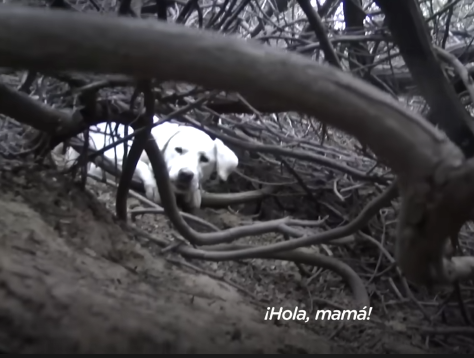
The location was quiet, almost eerily still. A narrow dirt path led us behind a cluster of abandoned buildings, where rusted metal sheets and broken wood created makeshift shelters. That’s where we saw her.
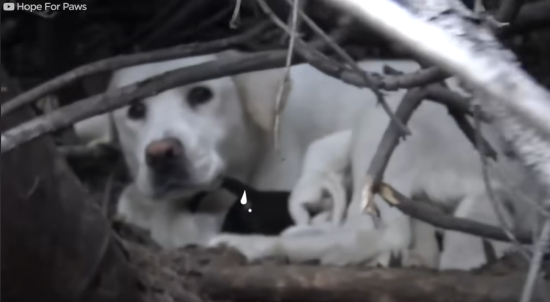
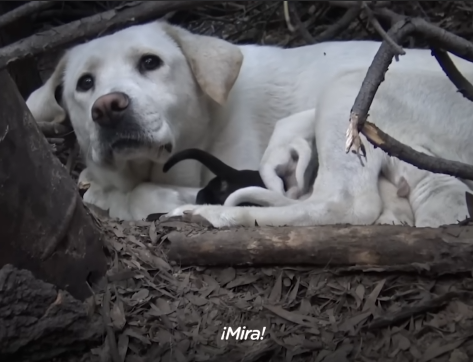
She was lying low, her body curled protectively around something hidden from view. Her fur—once likely golden and soft—was now dull, streaked with dirt and dust. Her ears perked up the moment she noticed us.
And then came the warning.
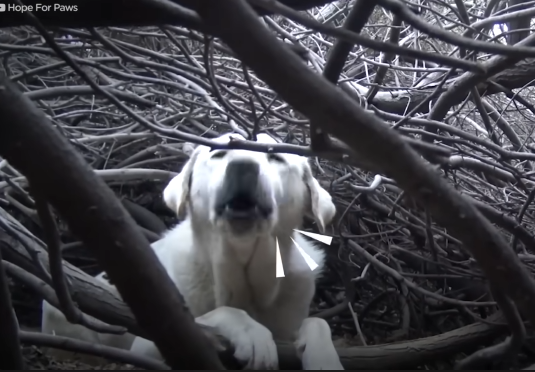
A low, steady growl.
Not aggressive in the usual sense—but firm. Clear. A message: Stay back.
We stopped immediately.
“There she is,” one of us whispered.
Her eyes never left us. They were sharp, focused, and filled with tension. She wasn’t going to run. She wasn’t going to hide.
She was going to defend.
We slowly crouched down, keeping our distance. “Hey, girl… it’s okay. We’re not here to hurt you.”
But she didn’t believe us.
Instead, she shifted slightly, tightening her body around whatever she was protecting. That’s when we caught a glimpse of tiny movement—small, squirming shapes nestled beneath her.
Puppies.
Newborns, by the look of it.
That explained everything.
A mother dog with puppies is one of the most protective forces in nature. Every instinct in her body was telling her that we were a threat. And given whatever she had been through to end up here—alone, on the streets—her fear made sense.
We needed a different approach.
Rushing in wasn’t an option. If we pushed too hard, she could panic—possibly even move the puppies somewhere more dangerous. Or worse, feel cornered.
So we waited.
We sat down a few feet away, making ourselves smaller, less intimidating. One of us gently placed a bowl of food on the ground and slid it forward.
She noticed it immediately.
But she didn’t move.
Not yet.
Her eyes flicked between us and the food, calculating, uncertain. Hunger was there—we could see it in the way her body trembled slightly, in how thin she looked beneath the dirt.
But her puppies came first.
Always.
Minutes passed.
Then more.
Finally, slowly, she extended her neck just enough to sniff the air. Her body remained tense, ready to react at any moment. Inch by inch, she reached toward the bowl, never taking her eyes off us.
When she took the first bite, it felt like a small victory.
“Good girl… you’re okay,” we murmured.
She ate quickly but carefully, constantly pausing to check on her surroundings. After a few mouthfuls, she shifted back, curling around her puppies again.
That was enough for now.
Trust doesn’t come in a single moment—it builds, piece by piece.
We returned later that day.
And the next.
Each time, we brought food, fresh water, and soft voices. Each time, we stayed just a little closer than before.
Gradually, something began to change.
Her growls became quieter.
Her posture softened—just slightly.
And one afternoon, as we approached, she didn’t growl at all.
She simply watched.
That was our opening.
We moved slowly, carefully, making sure every step was predictable. One of us extended a hand—not to touch, but to let her decide.
She hesitated.
Her nose twitched.
And then… she leaned forward.
Just enough to sniff.
It was the first moment of contact.
From there, everything shifted.
Over the next hour, we were able to get closer—close enough to see the puppies clearly. There were five of them, tiny and fragile, their eyes still closed. They nestled tightly against their mother, completely dependent on her warmth and care.
She watched us the entire time.
But she didn’t stop us.
That trust—hard-earned and fragile—was everything.
We knew we had to act soon. The area wasn’t safe. Passing vehicles, changing weather, and lack of proper shelter all posed risks. The puppies needed medical attention, and the mother needed rest—real rest.
The next day, we came prepared.
A soft crate. Blankets. More food.
As expected, she was cautious—but not aggressive. While she ate, we gently and quickly secured the puppies, wrapping them carefully to keep them warm. She noticed immediately and stood up, alert.
For a moment, tension filled the air.
Then something incredible happened.
Instead of panicking, she followed.
She stayed close, watching every move, as we placed the puppies into the crate. When we opened the door wider, giving her space, she hesitated only briefly—then stepped inside.
She wasn’t going to leave them.
Not for anything.
The ride to the rescue center was quiet. She stayed close to her puppies, her body pressed protectively against them. But there was no fear now—just vigilance.
And maybe… a little relief.
At the center, she was given a safe, warm space. Clean bedding. Fresh food. Water.
For the first time in a long time, she could rest without fear.
The puppies were examined—healthy, but in need of monitoring. The mother was underweight, exhausted, but strong.
Over the next few days, her transformation began.
She started to relax, her body no longer constantly tense. She allowed gentle petting, leaning slightly into the touch as if rediscovering what kindness felt like.
Her tail began to wag.
At first, just a little.
Then more.
And the puppies? They grew stronger each day, their tiny squeaks filling the room with life.
One morning, as we entered, something caught us off guard.
She walked up to us.
No hesitation.
No fear.
She wagged her tail and nudged a hand gently, as if to say, “Thank you.”
It was a moment we didn’t expect—but one we’ll never forget.
This stray Labrador, who once refused to let anyone near her puppies, had learned to trust again.
Not because she forgot her instincts.
But because she realized she didn’t have to fight anymore.
Now, she has a name. A safe place to raise her babies. And soon, a future filled with love and care.
Her journey reminds us of something simple, yet powerful:
Sometimes, the strongest resistance isn’t aggression—it’s love.
A mother protecting her young.
And when that love is met with patience, respect, and kindness… it can turn fear into trust.
One gentle step at a time.