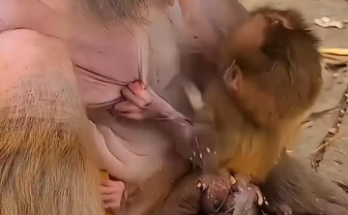
The phrase “It’s called an animal when it can attack” carries a weight that goes beyond its simple wording. At first glance, it may sound like a casual observation, perhaps even a joke, but underneath lies a deeper reflection on how humans perceive strength, danger, and the nature of living beings. Why do we associate the idea of being an “animal” so closely with the ability to attack? And what does that say about us?
In the natural world, survival is the ultimate rule. Animals are born into an environment where every movement, every decision, can mean the difference between life and death. Some animals hunt; others hide. Some rely on speed, others on camouflage, and many depend on their ability to fight back when threatened. The capacity to attack is often seen as power—a visible, immediate way to assert dominance or defend oneself.
When we say something is “an animal” because it can attack, we are focusing on this raw, instinctive side of nature. We imagine sharp teeth, quick reflexes, and a readiness to strike. It’s an image shaped by countless stories, documentaries, and even our own fears. A roaring lion, a charging bull, or a snapping crocodile—all of these examples reinforce the idea that to be an animal is to be capable of aggression.
But this view is only part of the story.
Most animals do not attack without reason. In fact, many avoid confrontation whenever possible. For them, attacking is not about cruelty or anger; it is about survival. A predator hunts because it needs food. A mother defends her young because it is her instinct to protect. Even the most fearsome creatures in the wild are not constantly looking for conflict. They conserve energy, avoid unnecessary risks, and act only when needed.
This raises an important question: if attacking is simply a survival mechanism, why do we emphasize it so strongly in our definition of what an animal is?
Part of the answer lies in human psychology. We are naturally drawn to extremes—especially those that involve danger. The idea of something being capable of attack triggers our awareness and sharpens our attention. It’s a survival instinct that has been passed down through generations. Recognizing threats quickly has always been essential for human survival, and so we have developed a tendency to focus on the aggressive traits of other beings.

At the same time, this perspective can be misleading. By defining animals primarily by their ability to attack, we overlook the complexity and diversity of their behaviors. Animals are not just fighters; they are also caregivers, builders, communicators, and even problem-solvers. Birds construct intricate nests, elephants show signs of mourning, and dolphins display remarkable intelligence and cooperation.
Reducing all of that to the single idea of “it can attack” simplifies a rich and varied reality into something one-dimensional.
Interestingly, the phrase can also be turned inward. Humans, after all, are animals too. Yet we often separate ourselves from the rest of the animal kingdom, as if our intelligence or social structures place us above it. But when humans act aggressively—when we fight, argue, or harm one another—we sometimes describe that behavior as “animalistic.”
This reveals a contradiction. On one hand, we define animals by their ability to attack. On the other hand, we use the term “animal” to describe behavior that we consider less civilized. It’s as if we project our own fears and judgments onto the natural world, creating a boundary that may not truly exist.
In reality, the line between human and animal behavior is not so clear. Both are capable of aggression, but also of kindness, cooperation, and empathy. The difference lies not in the presence of these traits, but in how they are expressed and controlled.
Perhaps the phrase “It’s called an animal when it can attack” says more about human perception than it does about animals themselves. It reflects our tendency to equate power with aggression, to see strength as something that must be proven through force.
But true strength can take many forms.
In the wild, survival often depends on balance rather than dominance. An animal that attacks too often may waste energy or attract unnecessary danger. One that never defends itself may not survive. The key is knowing when to act and when to hold back.

This idea can be applied to human life as well. Strength is not just about the ability to confront or overpower others; it is also about restraint, understanding, and the ability to choose peace when possible. The most powerful individuals are not those who attack at every opportunity, but those who know when it is truly necessary—and when it is not.
So, is it fair to define an animal by its ability to attack?
Not entirely.
Yes, the capacity for aggression is a part of the natural world. It is a tool for survival, a response to danger, and sometimes a means of obtaining resources. But it is not the whole picture. To focus only on that aspect is to ignore the richness of life and the many ways in which living beings interact with their environment and each other.
Maybe a better way to understand animals is to see them as they truly are: complex, adaptive, and deeply connected to the ecosystems they inhabit. Their behaviors—whether aggressive or gentle—are shaped by necessity, not by intention or morality.
And perhaps, in recognizing this, we can also gain a clearer understanding of ourselves.
Because in the end, the ability to attack does not define what it means to be an animal. It is simply one of many traits that exist within the broader spectrum of life.
What truly matters is how that ability is used—or not used.
And that, more than anything, is what separates instinct from wisdom.