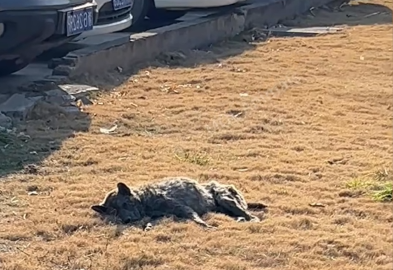
He had chosen a place where people rarely stopped—a narrow alley behind a row of crowded shops, where the smell of stale food mixed with damp concrete and discarded plastic. It was not a place for living things, only for what the world had thrown away. And now, that included him.
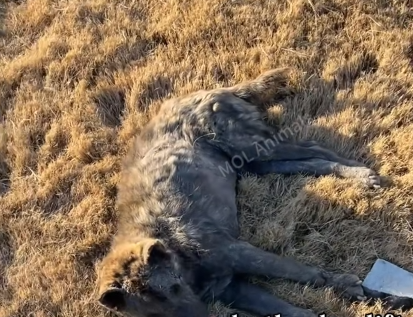
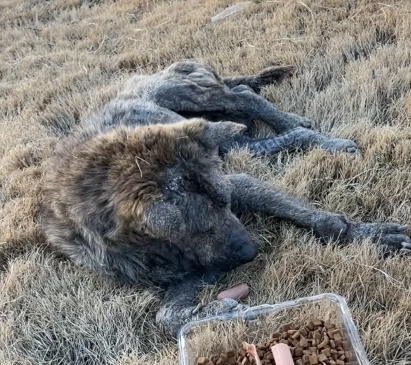
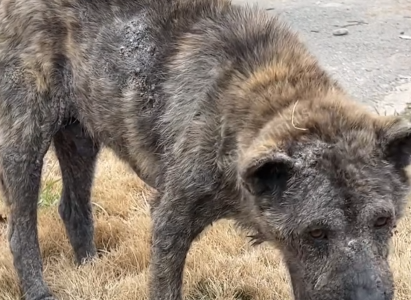
His body was thin beyond recognition, ribs pushing sharply against fragile skin that had once been strong and warm. His fur, patchy and matted, clung to him like a memory of better days. One of his legs dragged uselessly at an unnatural angle, and his breathing came in shallow, uneven waves. Each inhale seemed like a question. Each exhale, a quiet surrender.
People passed by.
They always passed by.
Some glanced at him briefly, their faces tightening in discomfort before they looked away. Others didn’t even notice, their eyes fixed on phones or lost in thoughts of their own lives. A few slowed down—but only to keep their distance, stepping around him as if he were something contagious, something to avoid at all costs.
To them, he was not a dog.
He was a problem.
A smell.
A shape in the corner of their vision that they hoped would disappear by morning.
But he had not always been like this.
There was a time—faint now, like a dream slipping through his fading mind—when he had known warmth. A small yard. A bowl filled regularly. A child’s laughter echoing in the afternoon sun. He remembered running, clumsy and joyful, chasing shadows and bouncing after things that moved. He remembered hands—gentle ones—that stroked his head and called his name.
He couldn’t remember the name anymore.
Only the feeling of belonging.
Something had changed. Perhaps it was when he grew older, or when he broke something valuable, or when life became harder for the people he trusted. He never understood the reasons. Dogs rarely do. They only understand love—and when it disappears.
One day, the gate had been left open.
Or maybe it had been opened.
He had wandered out, curious, unaware that the world beyond would not welcome him. When he returned, the gate was closed. The voices were gone. The yard was silent.
He waited.
For hours.
For days.
But no one came.
And so, he walked.
At first, he believed it was temporary. That he would find his way back. That someone would call him again with that familiar voice. But hunger has a way of changing hope into instinct. He began to search not for home, but for scraps.
The streets were not kind.
Other dogs fought him away from food. People shouted and threw things when he came too close. Rain soaked him. Sun burned him. Nights grew colder. Days grew longer. And slowly, the memory of who he had been began to fade.
Until he became what he was now.
A stray.
A forgotten thing lying in an alley, waiting for the end.
Flies gathered around him, drawn to wounds that had never healed properly. His eyes, once bright and full of life, were dull and half-closed. But somewhere deep inside them, a faint spark still flickered—an instinctive will to hold on, even when there was nothing left to hold on to.
Footsteps approached again.
He heard them before he saw them.
Slow. Hesitant.
Different.
The dog did not lift his head. He had learned that hope was often followed by pain. But the footsteps stopped near him, not hurried, not avoiding him like the others.
A shadow fell across his fragile body.
For a long moment, nothing happened.
Then, a voice.
Soft.
“Hey… you’re still alive.”
It wasn’t loud or dramatic. Just a quiet observation, almost as if the person was speaking more to themselves than to him. The dog’s ear twitched slightly.
No one had spoken to him like that in a long time.
There was no disgust in the voice. No fear. Just… something else.
Care.
A hand moved closer, slowly, giving him time. It didn’t grab or push. It simply hovered, waiting. The dog flinched weakly, expecting pain, but none came.
Instead, the hand gently touched his head.
Warm.
Careful.
Real.
For a moment, the world seemed to pause.
The dog’s breathing stuttered, not from pain this time, but from something unfamiliar. Something he had almost forgotten.
He shifted slightly, a small, trembling movement, as if responding to a distant memory buried deep inside him.
The person knelt down.
“You don’t deserve this,” the voice whispered.
No one else had stopped.
No one else had cared.
But this one did.
A piece of cloth was placed gently beneath his body. Another hand supported him as he was slowly lifted, his broken form handled with surprising tenderness. He whimpered faintly—not in fear, but in confusion. Why now? Why him?
The world moved again, but differently this time.
The alley faded behind them.
The smell of trash was replaced by fresh air.
The noise of passing strangers gave way to the steady rhythm of someone who had chosen, for reasons unknown, to stop.
To care.
To see him—not as trash, not as a burden, but as a life still worth saving.
The dog’s eyes opened slightly as he was carried. The sky above looked wider than it had in days. Maybe weeks.
Or maybe it was just that he was seeing it differently now.
His body was still weak. His wounds still real. The pain had not disappeared.
But something had changed.
He was no longer alone.
And sometimes, that is where survival begins—not in strength, but in connection.
Not in fighting alone, but in someone choosing to stand beside you when the rest of the world walks away.
The stray dog, who had once lain in an alley like discarded trash, waiting quietly for death, now rested in the arms of a stranger who refused to let his story end that way.
And for the first time in a long time, the dog did not feel like he was waiting to die.
He felt—just barely, but enough to matter—that he might still have a chance to live.